
How to Choose Travel Agency Automation Software
By dcs plus team on Sep 1, 2026, 10:36:28 AM
Selecting the right travel agency software for mid-office and back-office automation requires a clear understanding of your operational priorities. You need software that handles post-booking tasks, financial reconciliation, supplier management, and reporting while giving your team real-time visibility across the entire reservation lifecycle.
This guide walks you through the evaluation criteria, implementation considerations, and decision factors that determine whether a platform will scale with your business or become another bottleneck in your workflow.
dcs plus helps travel agencies gain control over their operations through TINA, an Agentic Travel ERP that automates mid-office and back-office processes from booking to balance sheet.
Key Takeaways: How to Choose Travel Agency Automation Software
- Mid-office software manages post-booking tasks including ticketing, quality control, and traveler notifications, while back-office handles invoicing and financial reconciliation.
- Evaluate platforms based on automation depth, API connectivity, multi-currency support, and integration capabilities with your existing booking tools.
- dcs plus TINA delivers end-to-end automation across mid and back-office functions with embedded AI for faster data access and decision-making.
- Real-time reporting and centralized data eliminate the operational silos that slow down high-volume travel agencies.
- Choose software that matches your business model, whether you operate as a TMC, DMC, OTA, tour operator, or wholesaler.
What Is Mid-Office and Back-Office Software for Travel Agencies?
Mid-office and back-office software handles everything that happens after a booking is made. The front office captures reservations through booking engines, OBTs, or agent desktops. The mid-office manages post-booking workflows. The back-office processes financial transactions.
Mid-office functions include quality control, ticketing, PNR data enrichment, itinerary generation, and traveler notifications. Back-office functions cover invoicing, supplier payments, commission tracking, and accounting integration.
Why Automation Matters for Mid-Office and Back-Office Operations
Manual processes create friction at every stage of the post-booking workflow. Agents spend hours on repetitive tasks: importing bookings from GDS systems, generating invoices, reconciling supplier payments, and preparing financial reports.
Automation eliminates these bottlenecks. Bookings flow automatically from third-party systems into your ERP. Invoices generate without manual data entry. Quality control rules run in the background, flagging exceptions before they reach your finance team.
The operational impact is measurable: faster processing times, fewer errors, lower cost-to-serve, and improved margins. For agencies managing high transaction volumes, automation is not optional. It is the operational infrastructure that determines whether you scale profitably or struggle under complexity.
How to Evaluate Travel Agency Automation Software
Start your evaluation by mapping your current workflows against what each platform offers. The goal is to identify gaps between your operational needs and available features.
Define Your Operational Requirements
Document every post-booking process your team handles manually. Include ticketing workflows, invoice generation, payment reconciliation, commission tracking, and supplier management. Note which tasks consume the most staff hours and which generate the most errors.
Consider your business model. A TMC managing corporate travel programs needs policy enforcement, considering service fees, duty of care tracking, and expense integration. A tour operator needs inventory management, package costing, and supplier coordination. Match your requirements to platforms built for your segment.
Assess Integration Capabilities
Your mid-office and back-office software must connect with your existing technology stack. This includes GDS systems (Amadeus, Sabre, Travelport, Apollo), booking engines, accounting software, and payment gateways.
API-first architecture enables these connections without custom development. Platforms with modern APIs can synchronize data in real time, eliminating the batch processing delays that create backlogs during peak periods.
Verify Automation Depth
Not all automation is equal. Some platforms automate basic tasks like invoice numbering. Others automate the entire lifecycle from reservation import to financial close.
Look for workflows that handle booking imports, quality control checks, ticketing triggers, document generation, payment processing, and accounting exports without manual intervention. The deeper the automation, the greater your operational efficiency gains.
What Features Should Mid-Office Software Include?
Mid-office software sits between your booking systems and your finance team. It ensures every reservation is complete, accurate, and ready for billing.
Automated Booking Import
Your mid-office should automatically import bookings from all sources: GDS, direct airline connections, wholesale systems, and API partners. Manual re-entry defeats the purpose of automation and introduces transcription errors.
Quality Control and Validation
Configurable rules should check every booking against your business policies. This includes fare accuracy, commission calculations, markup application, and compliance with client travel policies for corporate accounts.
Ticketing and Document Generation
Once a booking passes validation, the system should trigger ticketing and generate all required documents: e-tickets, itineraries, confirmations, and vouchers. Templates should be customizable to match your branding.
What Features Should Back-Office Software Include?
Back-office software manages the financial side of your travel operations. Every booking must be invoiced, every supplier must be paid, and every commission must be tracked.
Invoice Generation and Payment Processing
Your back-office should generate client invoices automatically based on booking data. This includes calculating taxes, applying markups, and managing multi-currency transactions. Payment tracking ensures you know which invoices are outstanding and which have been collected.
Supplier Reconciliation
Reconciling supplier statements against your booking records is time-consuming when done manually. Automated reconciliation flags discrepancies, tracks amounts due, and schedules payments according to contractual terms.
Commission Management
The system should track commissions receivable from suppliers, calculate amounts based on booking volume and contractual rates, and flag any missing payments for follow-up.
Financial Reporting and Accounting Integration
Real-time dashboards should show revenue, margins, and cash flow across your business. Integration with accounting software enables automatic posting of transactions to your general ledger, eliminating manual journal entries.
How Does dcs plus Address Mid-Office and Back-Office Automation?
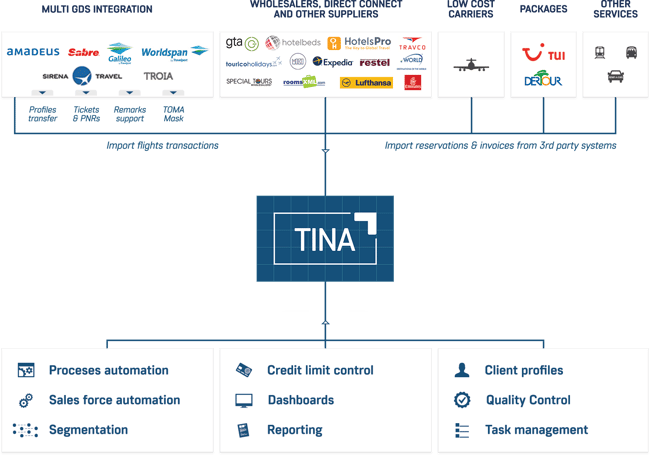
dcs plus TINA is a full web-based Agentic Travel ERP that combines mid-office and back-office functions in a single platform. The system automates post-sales workflows, manages client and supplier invoices, processes payments, and generates financial reports.
TINA automatically imports bookings from GDS systems, wholesalers, airlines, and other third-party platforms. Quality control rules validate each booking before it moves to invoicing. Document generation handles everything from vouchers to fiscal invoices with customizable templates.
The platform includes AI-powered features that surface operational insights and reduce manual effort. Teams can retrieve data, create CRM records, and perform routine tasks through conversational interactions rather than complex menu navigation. TINA now exposes its AI Assistant through an MCP server, an emerging industry standard connecting business applications to AI assistants such as ChatGPT, Claude, and other compatible tools, secured with OAuth-based authentication. Connect the AI tools your team already uses directly to TINA, and ask it to automate a task or pull information, without logging in and clicking through screens. Open Claude or ChatGPT. Ask for your top invoiced customers. That's it, TINA does the rest, no login required.
What Role Does API Connectivity Play in Travel Automation?
API connectivity determines whether your systems work together or operate as isolated silos. Modern travel agencies connect multiple content sources, booking platforms, and financial systems. Without APIs, data must be exported, transformed, and imported manually.
API-first platforms synchronize data in real time. A booking change in your GDS updates your mid-office automatically. An invoice generated in your ERP posts to your accounting system without file transfers.
dcs plus IRIX booking engine connects to multiple content sources including NDC airlines, GDS, and direct suppliers. This aggregated content flows into TINA for post-booking management, creating an integrated workflow from search to settlement.
How Should You Handle Multi-Currency and Multi-Market Operations?
Travel agencies operating across multiple markets face currency conversion, VAT calculation, and regional compliance requirements. Your automation platform must handle these complexities natively.
Multi-currency support should include automatic exchange rate updates, booking-level currency tracking, and reporting in multiple currencies. VAT and tax calculations should apply the correct rules based on service type, location, and client profile.
Centralized platforms allow you to manage multiple business units, brands, or regions from a single system. This eliminates the data silos that occur when each market operates its own software.
What Should You Expect During Implementation?
Implementing new mid-office and back-office software requires planning, data migration, configuration, and training. The timeline depends on your current system complexity, data volume, and integration requirements.
Data Migration Strategy
You need a clear plan for migrating customer profiles, supplier records, booking history, and financial data. Data cleansing before migration improves the quality of your new system from day one.
Configuration and Customization
Travel operations vary significantly between business models. Your platform should be configurable to match your workflows, document templates, approval hierarchies, and reporting requirements.
Training and Adoption
Staff training determines whether your team uses the new system effectively. Look for vendors that offer structured training programs, documentation, and ongoing support. dcs plus provides professional services including audits, tailored configurations, and knowledge transfer to support smooth adoption.
How Do You Calculate Return on Investment for Travel Automation?
ROI for mid-office and back-office automation comes from multiple sources: staff time savings, error reduction, faster processing, and improved margin visibility.
Time Savings
Track how many hours your team currently spends on manual booking imports, invoice generation, reconciliation, and reporting. Automation can reduce these tasks by 70-90%, freeing staff for higher-value activities.
Error Reduction
Manual data entry introduces errors that cost money: incorrect invoices, missed commissions, and billing disputes. Automated validation catches these issues before they reach clients or suppliers.
Processing Speed
Faster processing means faster cash collection. Automated invoicing reduces days sales outstanding. Real-time reconciliation ensures you pay suppliers on time and collect commissions without delay.
Margin Visibility
Real-time reporting shows profitability by product, destination, client, and agent. This visibility enables better pricing decisions and identifies underperforming segments before they drain resources.
What Questions Should You Ask Software Vendors?
Prepare a structured list of questions for vendor evaluations. Focus on operational fit, technical capabilities, and implementation support.
Operational Questions
- Which booking sources does the platform import from automatically?
- Level of automation
- How are quality control rules configured and managed?
- What document formats and templates are supported?
- How does the system handle multi-currency transactions and VAT calculations?
Technical Questions
- What APIs are available for integration with existing systems?
- Is the platform cloud-based or requires on-premise installation?
- How does the system handle high transaction volumes during peak periods?
- What security measures protect financial and customer data?
Support Questions
- What training and onboarding support is included?
- How are feature updates and enhancements delivered?
- What is the typical implementation timeline for agencies of your size?
- How does the vendor support ongoing configuration changes?
How Do You Avoid Common Selection Mistakes?
Agencies often make avoidable mistakes when selecting automation software. Understanding these pitfalls helps you make a more informed decision.
Focusing Only on Features
A long feature list means nothing if the platform does not fit your workflow. Focus on the features you will actually use and verify they work as described through demonstrations and reference calls.
Underestimating Integration Requirements
Every system your platform cannot connect to becomes a manual workaround. Map all required integrations before evaluating vendors and verify API availability for each connection.
Ignoring Total Cost of Ownership
Subscription fees are only part of the cost. Include implementation, training, customization, integration, and ongoing support in your budget calculations.
Choosing Based on Current Size Only
Select a platform that can grow with your business. Moving to a new system in two years because you outgrew your current one wastes the investment you made in implementation and training.
In Conclusion: Selecting the Right Travel Agency Automation Software
The right mid-office and back-office automation software becomes operational infrastructure that supports your growth. It eliminates manual bottlenecks, reduces errors, accelerates processing, and gives you visibility into the metrics that drive profitability.
Your selection process should match platform capabilities to your specific workflows, integration requirements, and growth plans. Evaluate automation depth, API connectivity, multi-currency support, and vendor expertise in the travel industry.
dcs plus delivers a complete technology ecosystem for travel agencies, combining mid-office automation, back-office financial management, and AI-powered intelligence in an integrated platform built for scalable operations.
- travel technology (61)
- Travel Industry (49)
- travel agency (31)
- travel erp (31)
- travel trends (28)
- travel booking system (23)
- TINA (21)
- travel company (19)
- Tour Operator (18)
- Product updates (17)
- Travel Management Company (17)
- AIDA (15)
- Business Travel (15)
- TBS (15)
- dcs plus news (14)
- tour operator solution (14)
- travel website (14)
- travel erp system (13)
- Corporate Travel (12)
- Mobile App (12)
- Travel App (12)
- mid back office solution (12)
- trends (12)
- Industry Events (11)
- Mobile Technology (11)
- TMC (11)
- travel agents (11)
- erp (10)
- erp system (10)
- Tour Operators (9)
- Travel booking engines (9)
- dcs plus (9)
- online travel agency (9)
- travel agent (9)
- Business Traveler (8)
- Mobile Bookings (8)
- travel (8)
- travel agencies (8)
- 2017 (7)
- Mobile Travel (7)
- travel business (7)
- travel software (7)
- Digital Technology (6)
- Insider (6)
- Millennials (6)
- Online booking systems (6)
- Travel Management Companies (6)
- process automation (6)
- travel companies (6)
- Big Data (5)
- Partners interviews (5)
- Tour Operator Software (5)
- corporate self booking tool (5)
- customer retention (5)
- travel agency technology (5)
- Booking engines (4)
- CSBT (4)
- Mobile Device (4)
- Mobile travel apps (4)
- OTAs (4)
- Static databases (4)
- Tour Companies (4)
- Travel Policy (4)
- Travel booking systems (4)
- Travel suppliers (4)
- back office automation (4)
- millennial travelers (4)
- online travel (4)
- responsive travel website (4)
- technology (4)
- travel website conversion (4)
- 2016 (3)
- AI in travel (3)
- Content mapping (3)
- Databases (3)
- Demographics (3)
- Food and Adventure Tourism (3)
- Mobile Apps (3)
- Travel Distribution Channels (3)
- Travel Management Software (3)
- Travel customers (3)
- Travel history (3)
- anniversary (3)
- automated processes (3)
- content matching (3)
- global travel industry (3)
- social media (3)
- travel agency workflow (3)
- travel back office (3)
- travel marketing (3)
- travel process automation (3)
- Advanced Booking Systems (2)
- B2B Travel Resellers (2)
- Bleisure (2)
- Branding (2)
- Business Process Automation (2)
- Business Travelers (2)
- Customer engagement (2)
- Financial Reporting (2)
- Food Tourism (2)
- Inbound Marketing (2)
- Infographic (2)
- Leisure Travel (2)
- Saas (2)
- Templates (2)
- Travel Costs (2)
- Travel bookings (2)
- Travel start-up (2)
- Travel website abandonment (2)
- WTM 2016 (2)
- abandoned travel bookings (2)
- engagement marketing (2)
- internet booking engine (2)
- millennial traveler (2)
- new travel company (2)
- office (2)
- online reputation management (2)
- online travel reviews (2)
- reporting (2)
- software (2)
- start-up tips (2)
- travel agency management (2)
- travel agency website (2)
- travel experience (2)
- travel mobile app (2)
- travel packages (2)
- travel reservation system (2)
- travel system (2)
- travelers (2)
- web-based travel erp (2)
- 2020 (1)
- 360 Customer View (1)
- Advanced Accommodation Contract Management (1)
- Adventure travelers (1)
- Apps (1)
- B2B Reseller (1)
- B2B Resellers (1)
- B2C (1)
- BI Reporting (1)
- Budget traveler (1)
- Cancellations (1)
- Chat (1)
- Chinese millennial (1)
- Cloud (1)
- Cognitive computing (1)
- Comparison shopping (1)
- Conference (1)
- Contact matching (1)
- Content (1)
- Cruise (1)
- Culinary traveler (1)
- Customer relations (1)
- Digital Innovation (1)
- Digital Natives (1)
- Documents (1)
- Emerging market travelers (1)
- Emerging markets (1)
- Errors (1)
- Experimental travel (1)
- Financial Dashboard (1)
- Import rates (1)
- Instant messaging (1)
- Integrate with Accounting Software (1)
- Internet (1)
- Luxury traveler (1)
- Mobile Transaction (1)
- Mobile payments (1)
- NDC distribution (1)
- Operational Reporting (1)
- Reseller networks (1)
- Resellers (1)
- Response (1)
- Subagents Network (1)
- TINA Academy (1)
- TTE (1)
- Travel Reseller Network (1)
- Travel Revenue Management (1)
- Travel booking problems (1)
- Travel finance reporting (1)
- Travel stats (1)
- WTM (1)
- abandonment (1)
- accomodations (1)
- advanced reporting (1)
- airline direct connect technology (1)
- ancillary services (1)
- cloud computing (1)
- collection (1)
- collection challenges (1)
- common data model (1)
- conversion rates (1)
- corporate mobile app (1)
- cost control (1)
- credo ventures capital invests in dcs plus (1)
- customer reviews (1)
- data analysis (1)
- dcs plus credo investment (1)
- dcs plus credo ventures (1)
- deloitte technology fast 500 EMEA (1)
- digital transformation (1)
- e-invoicing KSA (1)
- email marketing (1)
- email marketing for OTAs (1)
- erp e-invoicing (1)
- lost travel bookings (1)
- modern travel agencies (1)
- networks (1)
- new features (1)
- offers (1)
- online customer review (1)
- online reputation (1)
- online travel agencies (1)
- risk management (1)
- sales (1)
- senior travelers (1)
- shopping baskets (1)
- shopping carts (1)
- social network (1)
- standardized processes (1)
- static content (1)
- travel SaaS (1)
- travel account services (1)
- travel agency customers (1)
- travel agency profitability (1)
- travel analytics (1)
- travel blog (1)
- travel planning (1)
- travel reviews (1)
- travel shopping carts (1)
- travel software for agencies (1)
- travel software system (1)
- travel technology europe (1)
- travlist smart mobile app (1)
- trend (1)
- trusted adviser (1)
- trusted advisor (1)
- upsell functionality (1)
- vouchers (1)
- website traffic (1)
- zatca (1)
Subscribe by email
You May Also Like
These Related Stories

The Travel Industry is Cutting Costs with Back Office Automation

Are Workflow Problems Impacting Your Travel Agency?
No Comments Yet
Let us know what you think